
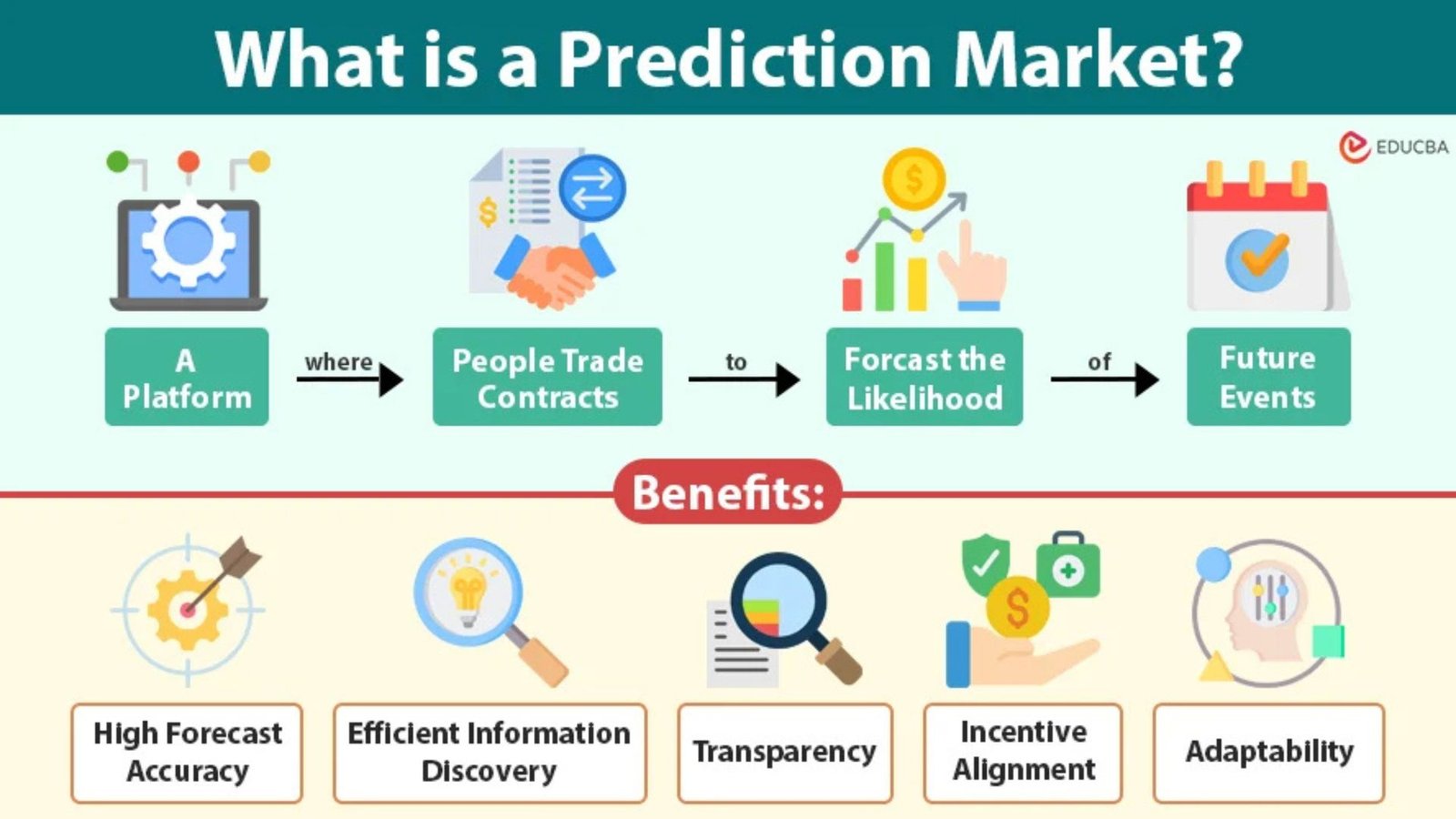
A prediction market is gaining attention as an innovative way to forecast future outcomes by combining financial incentives with collective intelligence. Instead of relying solely on expert opinions or static data models, this system enables individuals to trade on the likelihood of events. The result is a constantly updating reflection of public expectations.
The appeal of the prediction market lies in its ability to transform diverse opinions into measurable probabilities. As more participants engage, the accuracy of forecasts tends to improve, making it a valuable tool for decision-makers in various fields.
What Is a Prediction Market?
A prediction market is a platform where participants trade contracts based on the outcomes of future events. These contracts usually represent simple outcomes such as “yes” or “no.” The price of each contract reflects the perceived probability of that outcome occurring.
For instance, if a contract is priced at 0.65, it suggests a 65% likelihood that the event will happen. This pricing mechanism allows users to interpret market sentiment easily and make informed decisions based on real-time data.
How Prediction Market Works
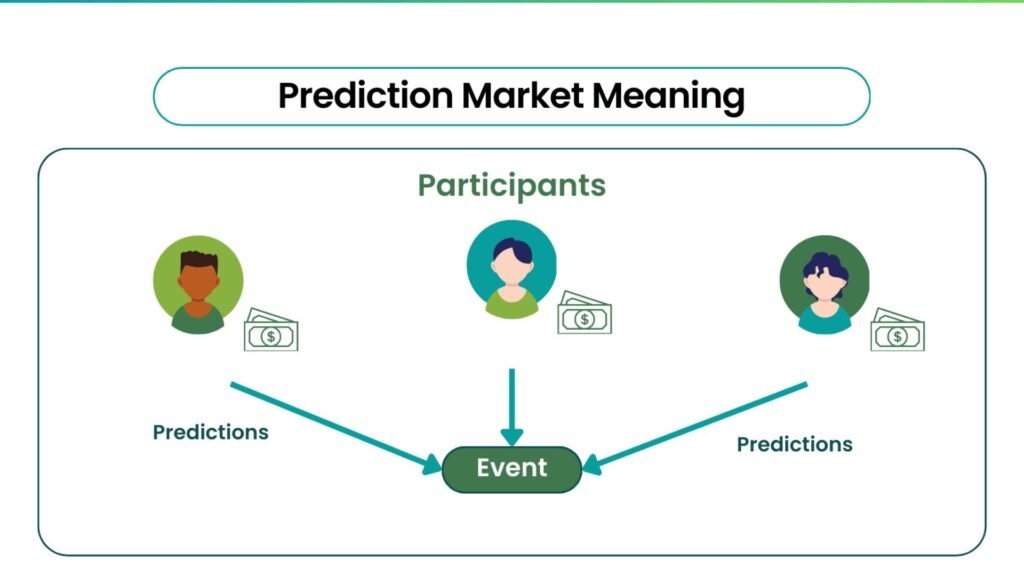
The structure of a prediction market is straightforward but highly effective. Participants buy shares in potential outcomes, and the value of these shares fluctuates depending on market demand.
If the predicted event occurs, the contract pays a fixed amount. If it does not, the contract becomes worthless. This creates a system where users are incentivized to make accurate predictions.
Prices adjust continuously as new information becomes available. When more people believe an event is likely, the price rises. When confidence drops, the price falls. This dynamic process ensures that the market remains responsive and relevant.
Key Features of Prediction Market Platforms
Several features define a successful prediction market:
- Real-time updates: Prices reflect the latest information
- Collective intelligence: Combines insights from many participants
- Transparency: Market data is visible and accessible
- Liquidity: Users can enter or exit positions easily
- Simple structure: Binary outcomes make participation straightforward
These characteristics make the both efficient and user-friendly.
Types of Events Traded in Prediction Market
A prediction market can be used to forecast a wide range of events, including:
- Political developments
- Economic indicators
- Financial trends
- Weather conditions
- Technological advancements
This flexibility allows the prediction market to be applied across multiple industries and disciplines.
Advantages of Prediction Market
The prediction market offers several important benefits that contribute to its growing popularity.
Improved Accuracy
By aggregating information from many individuals, the market often produces more reliable forecasts than traditional methods.
Incentive-Driven Insights
Participants are motivated by potential gains, encouraging careful analysis and informed decisions.
Fast Information Processing
Markets quickly respond to new developments, ensuring predictions stay current.
Wide Applicability
The system can be used in business, research, and strategic planning.
Risks and Challenges of Prediction Market
Despite its strengths, the also has limitations.
Regulatory Concerns
Legal frameworks differ across regions, creating uncertainty for participants.
Speculative Behavior
Some participants may treat it as a form of speculation rather than analysis.
Potential Manipulation
Large investors can influence market prices, affecting accuracy.
Financial Risk
Incorrect predictions can lead to losses, particularly for inexperienced users.
Prediction Market vs Traditional Forecasting Methods
Traditional forecasting methods rely on expert analysis, surveys, or historical data. While useful, these approaches can be slow to adapt and may not fully capture changing conditions.
In contrast, the continuously updates based on user activity. This real-time adjustment provides a more flexible and responsive forecasting tool, especially in rapidly changing environments.
Real-World Applications of Prediction Market
The use of the is expanding across different sectors.
Business Strategy
Organizations use internal markets to forecast project outcomes and improve planning.
Public Decision-Making
Institutions use these systems to anticipate policy impacts.
Financial Insights
Market signals help investors understand future trends.
Risk Assessment
Companies use predictions to identify potential uncertainties and prepare accordingly.
Legal and Regulatory Landscape of Prediction Market

The legal status of the varies globally. Some jurisdictions treat it as a financial instrument, while others classify it differently. As adoption increases, regulators are working to establish clearer guidelines to ensure fairness and transparency.
Understanding the regulatory environment is essential before participating in any platform.
Future Trends in Prediction Market
The future of the is shaped by technological advancements and increasing adoption.
Decentralization
New platforms are reducing reliance on centralized systems, improving transparency.
Integration with Advanced Technology
Artificial intelligence and data analytics are enhancing prediction accuracy.
Growing Adoption
More industries are exploring how this model can improve decision-making.
Regulatory Development
Clearer rules may encourage broader participation and trust.
Conclusion
The prediction market represents a modern approach to forecasting that combines financial incentives with collective knowledge. By transforming opinions into measurable probabilities, it provides a powerful tool for understanding uncertainty.
While challenges remain, its ability to deliver real-time insights and accurate forecasts makes it an increasingly valuable resource. As technology evolves, the is likely to play a key role in shaping future decision-making processes.
FAQs
What is a prediction market?
A prediction market is a system where people trade contracts based on the outcomes of future events, with prices reflecting probability.
How do participants earn in a prediction market?
Users earn by correctly predicting outcomes and buying contracts at favorable prices.
Is a prediction market reliable?
It is often considered reliable because it combines multiple perspectives into a single probability estimate.
Are there risks involved in a prediction market?
Yes, risks include financial loss, regulatory uncertainty, and potential market manipulation.
What makes a prediction market different from traditional forecasting?
It provides real-time updates and uses collective intelligence instead of relying solely on experts or past data.
